The transaction-bucket fallacy: custody mirrored the chain, not the operator.
The custody interface mirrored the blockchain's reality, where everything is a "transaction," instead of the operator's. Deploying a contract and calling mint sat in the same generic transaction order workflow. Non-technical operators such as compliance officers and treasury managers read hexadecimal logs and ABI definitions to run routine work, and a mint looked identical to a burn.
To a blockchain, minting a token and moving funds are just transactions. To a CFO, they are two different worlds.
This was a business risk, not a usability complaint. Interviews across trading, treasury, compliance, and payments teams, plus an audit of competing custody platforms, surfaced four compounding frictions:
- Fragmented workflows: contract actions were buried inside generic transaction lists.
- No cross-chain scale: the model wasn't network-agnostic, so engineering duplicated work for every Ethereum Virtual Machine (EVM) chain.
- Clarity and risk: with no human-readable guardrails, misconfiguration and compliance exposure rose.
- Unpredictable cost: volatile network fees (gas) and manual upgrades made budgeting guesswork.
Each one suppressed a strategic, revenue-bearing surface. The reframe: the intent was almost always asset management, but the friction lived entirely in the technical lifecycle. Institutions don't operate in transactions; they operate in actions: issue, mint, redeem, govern.
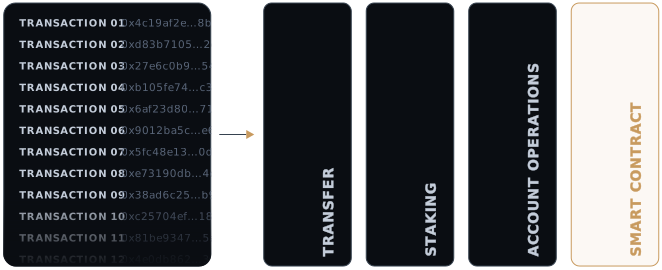
Four intent pillars and a template-driven Contracts Hub.
I unbundled the monolithic transaction model into four operational pillars: Transfer, Staking, Account Operations, and Smart Contract. Smart contracts got their own home — a Contracts Hub spanning the full lifecycle: deploy, call, query, monitor, and upgrade, across all four supported EVM chains on one network-aware surface.
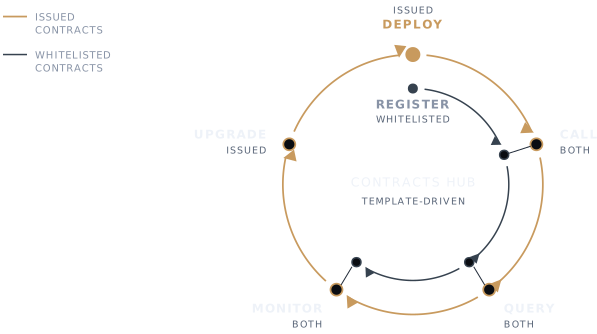
The Hub resolves intent two ways. First, through two contract groups:
- Issued: contracts configured and deployed through the platform.
- Whitelisted: trusted external contracts the platform interacts with.
Second, through a library of no-code, use-case templates. Picking "Issue Token" launches a guided wizard instead of a blank code editor, standardizing Issue, Mint, and Redeem for tokenization while preserving ABI decoding for custom calls. Before an operator signs, the Hub surfaces real-time ABI validation, gas estimation, and a simulation preview of the resulting state changes, so cost and effect are explicit at the point of action.
Turning raw Solidity methods into safe, repeatable business actions.
The tradeoff was scope: a focused minimum viable product over a universal hub on day one. I bet intent-first primitives would generalize, with tokenization the first and highest-volume beneficiary.
The real change was underneath.
Go behind the build to see how it was built, how the numbers moved after launch, and what it set in motion across the platform.