A PRD with no user.
The PRD described a system that minted, distributed, and redeemed itself across chains. It never described a user: the operator who would actually run it. In practice, operators stitched those actions together across spreadsheets, ticketing queues, email, and chat, with no shared operating model and no single source of truth. What the company thought it was shipping was a token; what it actually had to run was the operation underneath it.
Stablecoins don't operate themselves; a stablecoin with no operator is one no one can run.
That operation is concrete, and it sets the real requirements. A stablecoin team runs a handful of daily loops, each bound to an external clock it does not control:
- Peg loop: reconcile bank reserves against on-chain supply, watch redemption-queue depth against cash on hand, hold the cover ratio. Bound to the banking calendar: wire and settlement cutoffs, no weekends.
- Compliance loop: triage Know Your Transaction (KYT) alerts, rescreen the holder base on every sanctions-list change. Bound to the sanctions calendar: lists update several times a week, unannounced.
- Transfer loop: approve mints and redemptions, sign multi-party transfers, clear failed or stuck settlements.
- Reporting loop: archive the day's reserve-adequacy snapshot a regulator may sample, and the audit evidence behind every state change. Bound to the regulator's calendar.
The risk was structural, not incidental. There was no live view of whether reserves backed circulating supply one-to-one, the reserve cash sat siloed from operations, and compliance was bolted on rather than built in. A gap here doesn't degrade usability; it blocks launch readiness or invites regulatory intervention.
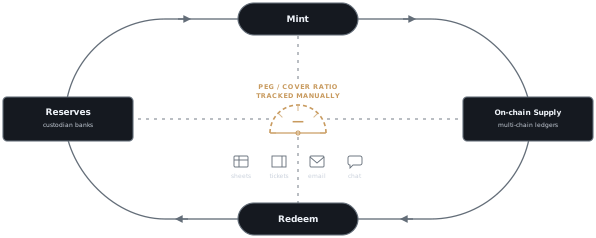
One comprehensive prototype as a decision instrument.
Rather than argue the roadmap in the abstract, I ran market entry as design due diligence: build one comprehensive prototype of the full white-label stablecoin operating model end to end, spanning onboarding, multi-chain mint and redeem, Role-Based Access Control (RBAC), peg and reserve monitoring, and crisis controls, so the operational complexity became something leadership could operate and price, not estimate.
We didn't debate features; we simulated operations.
The structural insight reframed the decision. The branded RLUSD path is a different go-to-market model that runs on a constrained slice of the same platform: one regulated issuer, one brand, fixed fees, a single tenant. So the question was never "which product to build." It was which path to take to market first: ship the de-risked branded path now, or build the full white-label platform first. A reworked decision matrix compares those two directions directly.
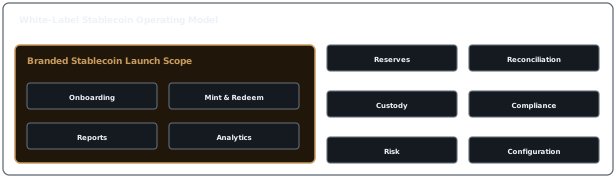
The tradeoff was deliberate. Simulating the whole model before committing is slower than shipping a thin surface, but building the superset first surfaced every regulatory and operational obligation the branded path would inherit, so nothing launched that we would later have to re-architect. Prototyping here is not a UX artifact; it is the instrument that turns an executive bet into an operational rehearsal.
The simulation made the call.
Go behind the build to see how one prototype decided the launch, what shipped, and why it's back on the table in 2026.